
MASTERING GENERATIVE AI & PROMPT ENGINEERING
19th-20th February, 2026 22nd-23rd April, 2026
23rd-24th July, 2026 1st-2nd December, 2026
Introduction
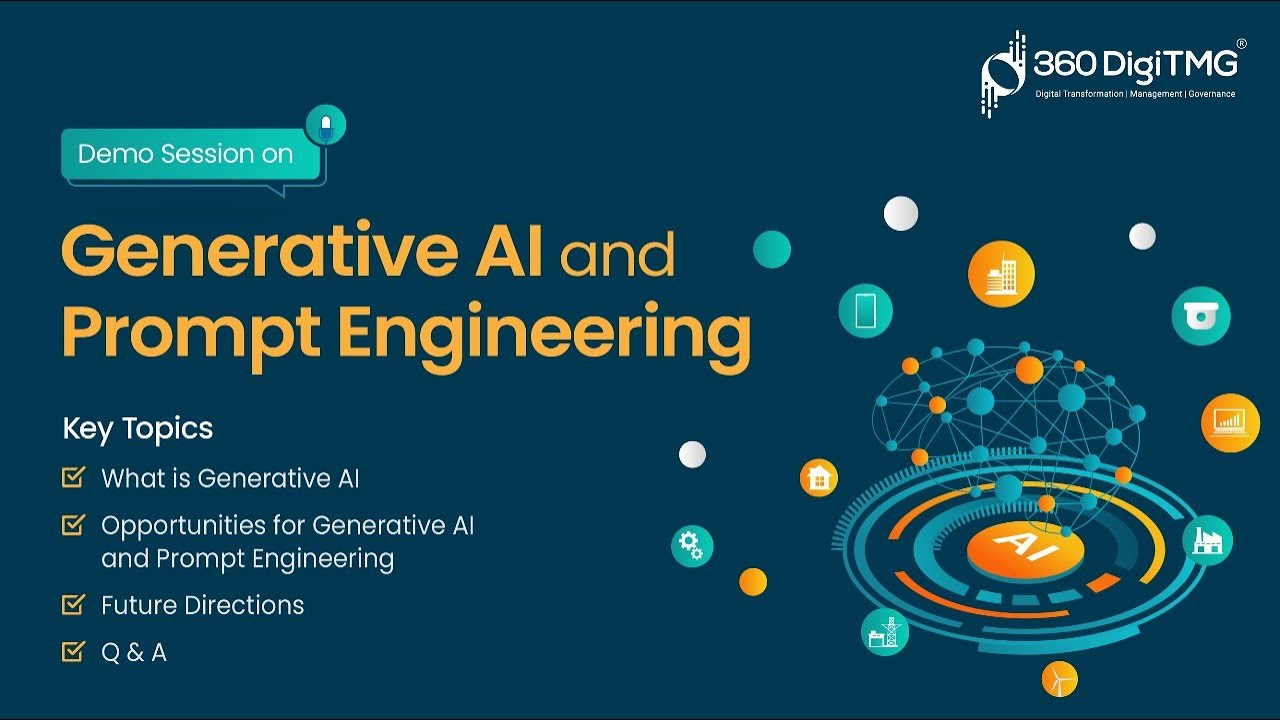
Generative AI (GenAI) refers to AI models, such as LLMs, that create new content (text, images, code) using trained data. Prompt engineering is the essential skill of crafting, refining, and optimizing these inputs (prompts) to guide models toward producing accurate, relevant, and high-quality outputs. Key techniques include defining roles, providing context, and using examples to improve performance.
Generative AI and Prompt Engineering covers designing, testing, and refining prompts to optimize AI outputs, spanning foundational LLM concepts to advanced techniques like chain-of-thought, persona adoption, and
multimodal prompting. Key modules typically include prompt structure, parameter tuning (temperature/top_p),
ethical considerations, and practical applications in text, code, and image
Key Aspects of Generative AI & Prompt Engineering:
- Definition & Importance: Prompt engineering acts as a bridge between human intent and AI capability, ensuring the generated output is precise and useful. It is considered a crucial, high-value skill for maximizing
productivity with tools like ChatGPT, DALL-E, and GitHub Copilot. - Components of a Good Prompt: Effective prompts often include specific instructions, context, input data, and desired output formats (e.g., tone, length, structure).
Module One: Foundations of Generative AI
- AI & LLM Mechanics: Understanding Large Language Models (LLMs), tokenization, and how transformers process language.
- Model Architectures: Exploring Generative Adversarial Networks (GANs), Variational Autoencoders (VAEs),
and Diffusion models for image generation. - Neural Networks: Core concepts like backpropagation, deep learning architectures, and Natural
Language Processing (NLP) implications.
Module Two: Core Prompt Engineering Techniques
- Zero-Shot & Few-Shot Prompting: Learning to get results with no examples versus providing a few demonstrations to guide the model.
- Chain-of-Thought (CoT): Guiding the AI to show its “reasoning” steps to solve complex logic or math
problems. - Role/Persona Prompting: Instructing the AI to adopt a specific professional or historical persona to influence
tone and expertise. - Iterative Refinement: Methods for systematically tweaking prompts (Role, Task, Context, Output Format) to
improve accuracy.
Module Three: Advanced & Agentic AI Strategies
- Reasoning Frameworks: Complex strategies like Tree of Thoughts (ToT), Least-to-Most prompting, and Self-Consistency.
- Agentic AI & Autonomy: Designing autonomous agents using tools like LangChain, CrewAI, or AutoGen that can plan and execute multi-step tasks.
- Retrieval-Augmented Generation (RAG): Integrating external data (vector databases) to ground AI responses in factual, private, or up-to-date information.
- Meta-Prompting: Using AI to write or optimize prompts for other AI models.
Module Four: Specialized Applications & Tools
- Multimodal Prompting: Techniques for generating and refining images (e.g., Midjourney, DALL-E) and
audio/video. - Development Tools: Hands-on labs with IBM watsonx, OpenAI Playground, and Python-based libraries like DSPy for prompt optimization.
- Code Generation: Leveraging AI for programming, debugging, and software development.
Module Five: Ethics, Security & Governance
- Security Threats: Identifying and defending against Prompt Injection attacks, jailbreaking, and data leakage.
- Bias & Fairness: Strategies for detecting and mitigating hallucinations, gender/racial bias, and ensuring responsible AI usage.
- Evaluation Metrics: Using frameworks like RAGAs or metrics like BLEU and ROUGE to measure AI
performance.
Duration: Two (2) days Fee: N180,000
Phone No:
08052062320, 08095284269
08168381962
Email Address
training@nazellinkconsult.com info@nazellinkconsult.com
Contact Info
Address
2nd Floor, Acme House, 23, Acme Road, Ogba, Ikeja,Lagos. Nigeria.
Phone No:
08052062320, 08095284269,
07085271570
Email Address
info@nazellinkconsult.com